
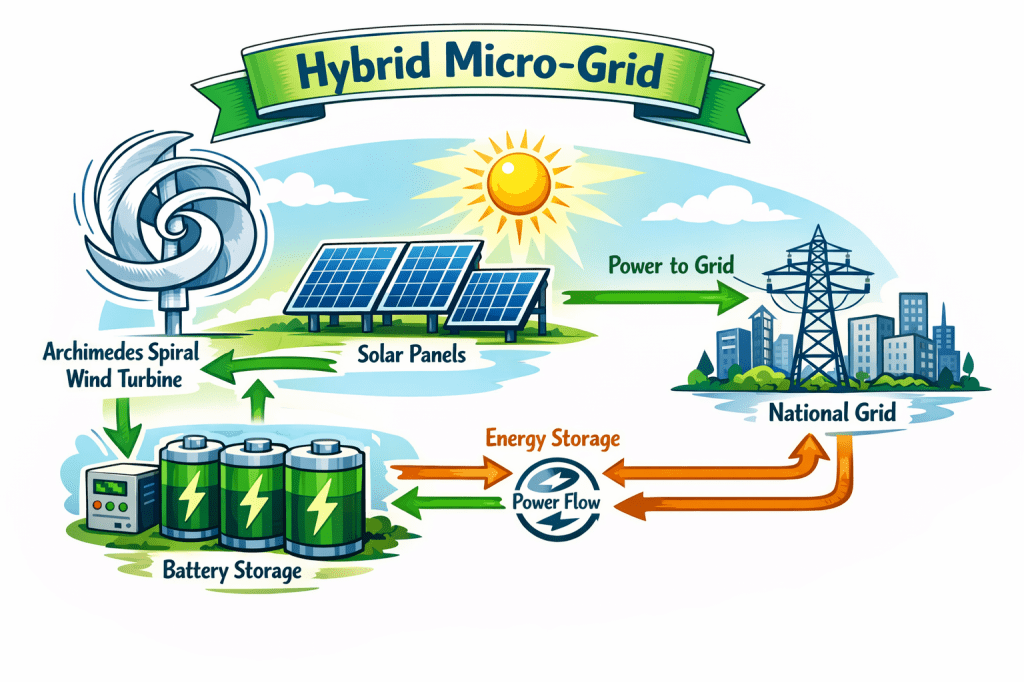
In a world still too reliant on fossil fuels, simply hoping the national grid becomes greener isn’t enough. While progress is being made, the reality is that grid electricity in the UK still depends in part on gas and other non-renewable sources—especially during peak demand and in winter.
If the goal is to genuinely reduce carbon impact and take control of energy use, the conversation needs to shift from grid reliance to personal energy independence. And the most practical way to move in that direction is through hybrid systems—combining solar panels, small wind turbines, and battery storage.
Solar panels are an excellent starting point, but they have a built-in limitation: they generate most of their energy during daylight hours and in summer. Unfortunately, that doesn’t align with when UK households need energy most—dark evenings and long winter months.
This is where small wind turbines make a critical difference. In the UK, wind is strongest in autumn and winter, and it continues generating overnight and during storms—precisely when solar cannot. Rather than competing with solar, small wind turbines complement it, filling in the gaps and creating a more balanced, year-round energy supply.
A future UK household system might include 10 solar panels (around 4–4.5 kWp), a 1 kW wind turbine, and an 8–12 kWh battery. Solar alone would produce around 3,500–4,000 kWh per year, but heavily skewed toward summer. Adding small wind turbines contributes an extra 800–2,000 kWh annually, much of it during darker, colder periods.
Together, this creates a system capable of generating 4,200–6,000 kWh per year—enough to cover most or all of a typical household’s electricity needs, with far less seasonal imbalance. Instead of turning back to the grid in winter, the home becomes far more self-reliant.
Battery storage plays a key role in making this work. With solar alone, batteries tend to charge during the day and fully discharge overnight, leading to frequent and deep cycling—particularly in winter. By introducing small wind turbines into the system, the battery can be topped up overnight and during poor weather, reducing how hard it has to work. This means fewer deep cycles, less wear, and ultimately a longer lifespan—protecting one of the most expensive parts of the system.
Small wind turbines have sometimes been criticised as being mis-sold, and in some cases that criticism is justified. Issues typically arose when turbines were installed in unsuitable locations or promoted as standalone solutions. But that misses their real value. Small wind turbines are not a replacement for solar—they are a complement to it. When used as part of a hybrid system, they become a powerful tool for reducing reliance on the national grid and provide a keystone for energy self reliance.
A system like this typically costs between £15,500 and £24,000, with annual savings and export income in the region of £750 to £1,300. That leads to a payback period of around 11–16 years. While that may be slightly longer than solar alone, it delivers something far more important than simple payback: resilience, consistency, and control.
Because the real objective isn’t just cheaper electricity—it’s less dependence on a grid that still relies on fossil fuels and faces volatility beyond the control of our economy.
The key takeaway is simple. If we are serious about reducing our environmental impact and protecting ourselves from rising energy costs, we can’t just rely on the grid to change. We need to change how we generate and use energy at home.
And in the UK, that means moving beyond solar alone—toward a hybrid approach that works with the climate, not against it.
 Blog
Blog 
Leave a comment