
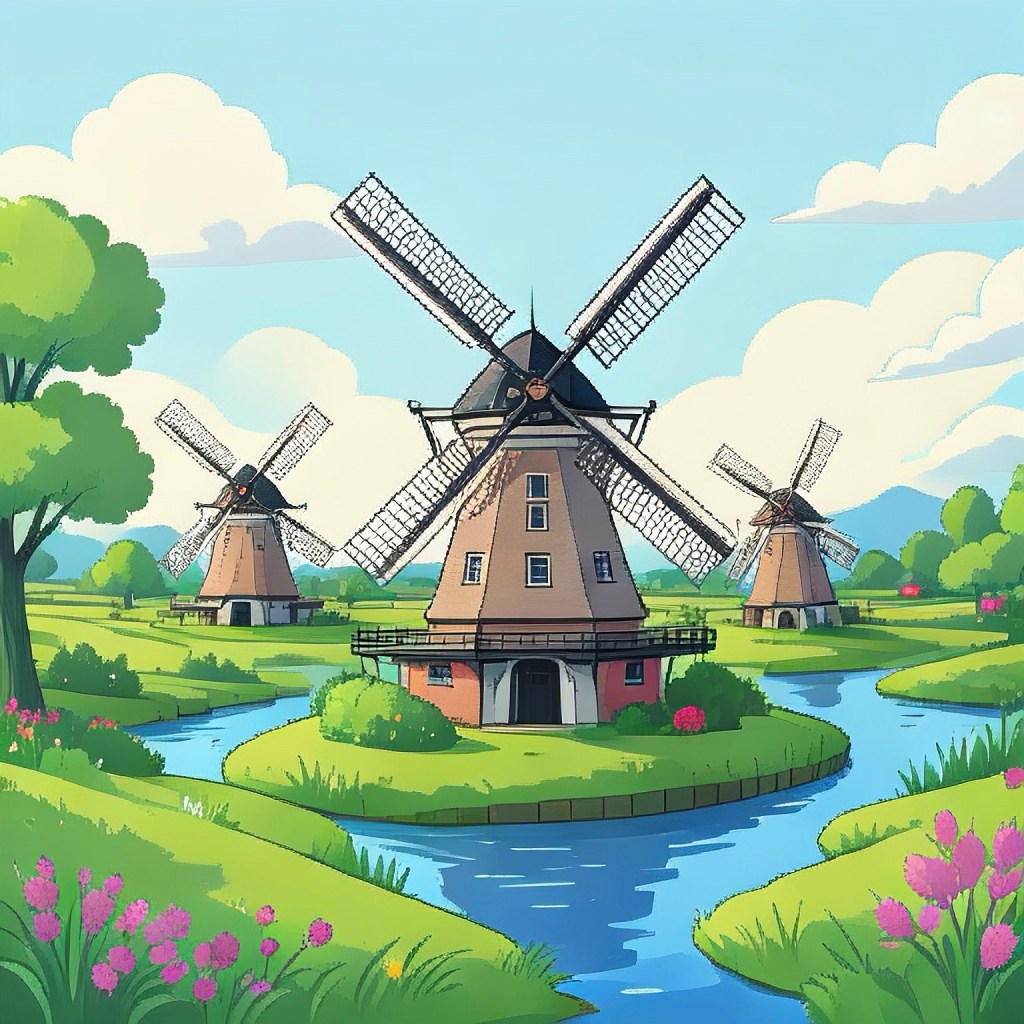
For centuries, the iconic windmills of the Netherlands were among the most advanced machines in the world. They drained lakes, powered sawmills, ground grain, pressed oil, and helped build one of Europe’s richest trading economies.
But despite their sophistication, classic Dutch windmills had one fundamental weakness:
They only worked when the wind was blowing.
That limitation shaped everything about preindustrial life. Work schedules, water management, manufacturing output, and even public safety depended on the weather. Today, we usually think of batteries as companions to solar panels and modern wind turbines — but if modern battery storage had existed during the Dutch Golden Age, it could have transformed the entire economy.
The Power of a Classic Dutch Windmill
A typical Dutch windmill produced somewhere between 5 and 30 kilowatts of mechanical power depending on its size and purpose.
That may sound small today, but in the 1600s it was enormous. A large industrial sawmill delivering 20 kW continuously was equivalent to roughly 27 horsepower — enough to replace large teams of laborers and animals.
At their peak, the Netherlands may have had 8,000 to 10,000 windmills operating across the country.
These mills powered:
• Water pumps for polders
• Timber sawmills
• Flour mills
• Paper mills
• Oil presses
• Industrial workshops
In many ways, they formed the world’s first large-scale renewable industrial network.
Windmills Already Worked Around the Clock
Many Dutch windmills operated day and night whenever conditions were favorable.
Polder drainage mills especially had to run continuously during storms or flooding risks. Industrial mills also took advantage of strong nighttime winds whenever possible.
But there was a catch:
• If the wind stopped, production stopped.
• If demand disappeared, excess power was wasted.
• If flooding continued during calm weather, pumps could not keep up.
This is exactly the problem modern batteries solve.
The Missing Piece: Energy Storage
Imagine a 17th-century Dutch windmill connected not just to gears and shafts, but to:
• an electric generator,
• a battery bank,
• and electric motors.
Suddenly, the windmill becomes something entirely different.
Instead of immediate mechanical work only, wind energy could now be:
• captured,
• stored,
• distributed,
• and used later.
A single 20 kW windmill running through a windy 10-hour night could theoretically store around:
200 kWh of energy
That is enough energy to:
• power efficient lighting for a village,
• run workshops during calm periods,
• continue operating pumps after storms,
• or provide stable power for industrial machinery.
Water Management Would Have Changed Dramatically
The Netherlands depended on constant water control. Entire regions existed only because wind-powered pumps kept them dry.
Historically, calm weather after heavy rain was dangerous because pumping capacity suddenly vanished.
With batteries:
• storm winds could charge storage systems,
• electric pumps could continue working after winds faded,
• water levels could be controlled more steadily and efficiently.
In practical terms, this could have made Dutch flood defenses significantly more resilient centuries before modern electrical infrastructure existed.
From Mechanical Power to Electric Networks
Traditional windmills transmitted energy mechanically:
• gears,
• rods,
• crankshafts,
• belts,
• and rotating shafts.
Mechanical transmission works well locally but becomes inefficient over distance.
Electricity changes everything.
If Dutch mills had access to generators and batteries:
• power could be sent by wires,
• multiple buildings could share energy,
• workshops could operate independently from the mill itself,
• lighting could extend productive hours,
• and villages could form early microgrids.
Even relatively small amounts of power become far more useful when they are flexible.
Better Efficiency Without More Wind
Battery storage does not create more wind energy, but it dramatically improves how useful that energy becomes.
Without storage:
• workers waited for wind,
• machinery sat idle,
• excess windy-period power was lost.
With storage:
• machinery could operate steadily,
• industrial output becomes predictable,
• labor becomes more efficient,
• and economic productivity rises.
This is the same principle behind modern renewable energy systems today.
Could the Dutch Have Built an Early Renewable Civilization?
The most fascinating possibility is scale.
If even 8,000 windmills averaged only 10 kW of usable output, the Dutch system represented something like:
80–100 megawatts of distributed renewable power
For a preindustrial society, that is extraordinary.
With modern:
• battery storage,
• electric motors,
• generators,
• and power electronics,
the Dutch Republic might have developed a decentralized electrical economy centuries early.
Not modern by today’s standards, of course. A traditional windmill could never compete with a modern power station in raw power density.
But it could have created:
• electrically lit towns,
• battery-backed flood defenses,
• distributed industrial workshops,
• and resilient local energy networks long before the industrial revolution fully unfolded.
The Bigger Lesson
The story of Dutch windmills highlights something important about renewable energy:
Generation is only half the challenge.
Storage and distribution are what transform intermittent energy into dependable infrastructure.
The Dutch mastered wind power centuries ago. What they lacked was the ability to save it for later.
Modern batteries would not merely have improved the classic windmill — they would have fundamentally changed what wind-powered civilization could become.
 Blog
Blog 
Leave a comment